NUAR Gallery invites journalists, collectors and art enthusiasts to the private preview of the exhibition What Lies on the Surface of a Weightless Space on July 6th 2026 at 9.00 pm at Nuar Gallery Capo Boi, in the beautiful context of Falkensteiner Resort Capo Boi 5*, Via Cagliari 65 Villasimius CA.
The evening will open with a special live painting performance by the artist Luigi Di Fabio, offering an exclusive glimpse into his artistic practice and the creative process behind the creation of his work.
The official opening of the exhibition will take place on Tuesday 7 July at 7.00 pm and will be followed by a meet-and-greet with the artist. We kindly ask visitors to confirm their attendance at info@nuargallery.com
A body walking. A colour taking shape. Space filling up.
A body walking. A bouquet of flowers. A window.
Something tangible, yet so ephemeral, light, floating.
This is how we present What Lies on the Surface of a Weightless Space: a sensitive dialogue between Iris Kojaman and Luigi Di Fabio.
Both artists explore lightness as an aesthetic and existential condition, working on the surface of a space that possesses neither depth nor defined boundaries. An imaginative, mental place even before it is a physical space, in which matter loses its weight and hovers in a fragile equilibrium that yearns for eternity. Whilst for Luigi Di Fabio, lightness is achieved through subtraction, Iris Kojaman manifests it through the continuous expansion of colour.
In his works, Luigi Di Fabio reduces colour to its essence. Figures, backgrounds and details share the same tonal quality. The artist’s palette is narrowed down to a single tone, which eliminates excess and, through subtle variations in light and thickness, reveals the depth and presence of the figures. These are smoothed, thinned out, almost suspended: bodies, animals, balloons, paper aeroplanes and fragile creatures seem to defy the force of gravity and remain ‘frozen’ in a moment of carefree existence, made eternal by the choice of medium and surface. It is a fragile moment, destined by its very nature to disappear. The materials themselves play a part in this endeavour: the raw, unprepared canvas reflects and amplifies the subtlety of the colour, allowing light to pass through it; the frame, painted in the same shade, does not enclose the space but extends it, allowing the image to continue beyond the edge. For Di Fabio, lightness stems from a single thought: the desire to capture that which slips away. In the work Su nuvole di plastica, the movement of a multitude of legs – perhaps belonging to the same person – is captured, depicted in successive moments, dancing on feather-light balloons. Nothing suggests a destination; nothing indicates the passage of time. The scene appears suspended in balance, as if the painting were preserving the exact moment when a memory ceases to belong to the present but has not yet become the past.
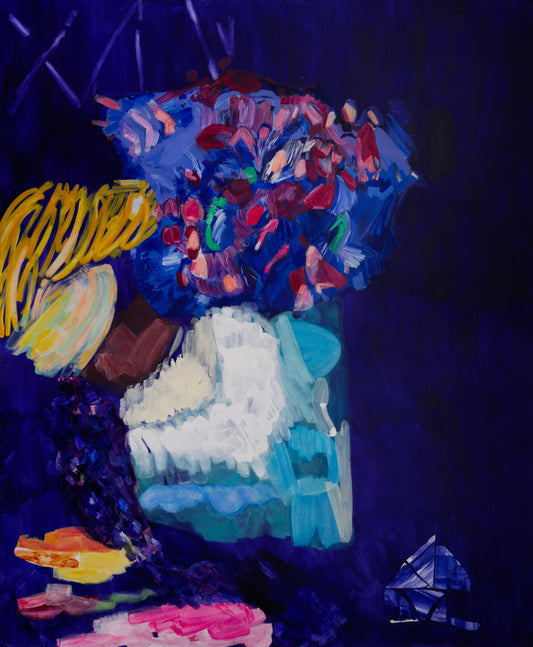
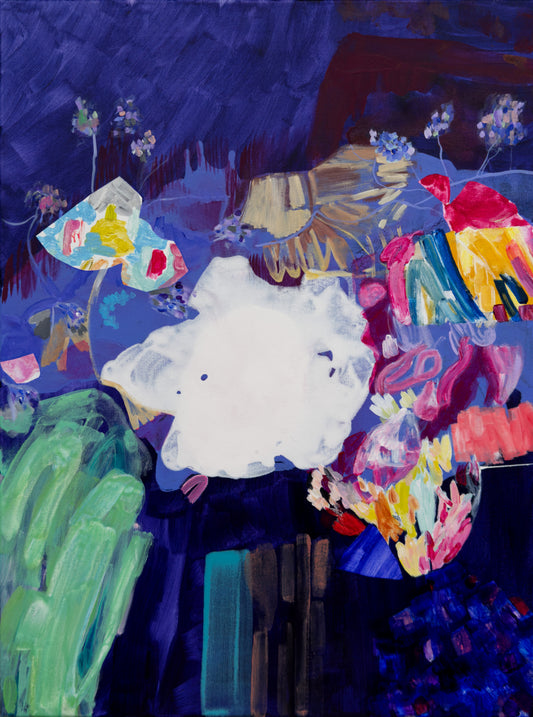
In Iris Kojaman’s art, however, it is colour that is the guiding principle and driving force; form does not precede it, but is a direct consequence of it. Her palette is broad; her brush, like a conductor’s baton, masterfully directs the colours, orchestrating combinations and overlays until forms emerge from the colour itself. In her paintings, colours take centre stage; they vibrate with hues that meet, embrace, separate and dance across the canvas. Not only pigments, but also small fragments of everyday paper – cut out and arranged on the canvas using the collage technique – enrich her works with vibrancy and intrigue, making them, in turn, a testament to lived experiences that find their way into her art. In Scottish Bouquet, one of the canvases on display, fragments of colour coalesce and disperse simultaneously. Bright hues and cut-out surfaces coexist in a dynamic balance that seems never to reach a definitive form. The viewer’s gaze is invited to follow the movement of the colours rather than to seek out a subject, as if the work were capturing the very moment when a sensation takes shape even before it becomes an image.
The juxtaposition of the two artistic languages creates a visual space in which lightness and suspension combine without repeating themselves. Iris Kojaman gives form to the formless through a generous use of colour, whilst Luigi Di Fabio achieves lightness through subtraction, transforming a single tone into multiple layers of subtle depth.
What lies on the surface of a weightless space demonstrates that space is a suspending surface, a field that accommodates figures and objects in environments without coordinates, where the slightest hints suffice to indicate a presence and yet are capable of holding the memory of a fleeting moment.
The exhibition’s title stems precisely from this reflection: what lies on the surface of a weightless space? Perhaps nothing tangible, perhaps only traces of memories and moments illuminated by a warm light streaming through the window, of colours that fade as the hours pass. Lightness is not fleeting indifference or frivolity, but a profound attempt to make the human experience less finite.
Curated by Priscilla Melchionno